Training open to CISLI Active Members or those eligible to become Active Members only. (See https://cisliireland.wordpress.com/home/constitution/ part 3.2). To register please text 085 1051792 Or email cormac.leonard@gmail.com
Training open to CISLI Active Members or those eligible to become Active Members only. (See https://cisliireland.wordpress.com/home/constitution/ part 3.2). To register please text 085 1051792 Or email cormac.leonard@gmail.com
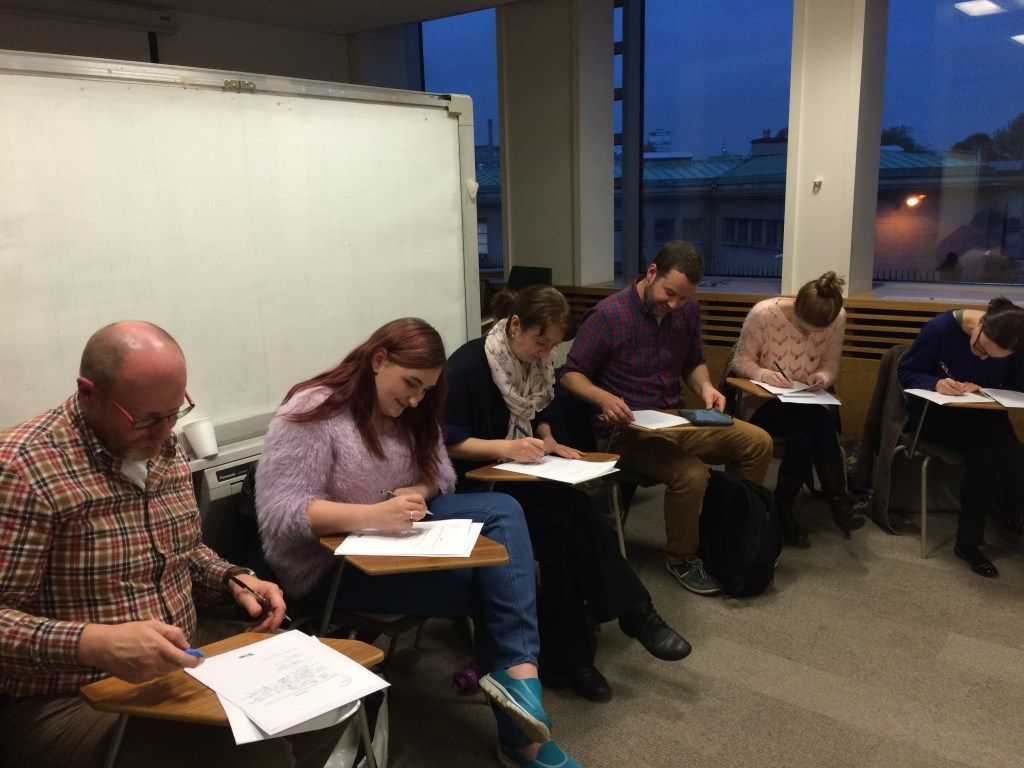
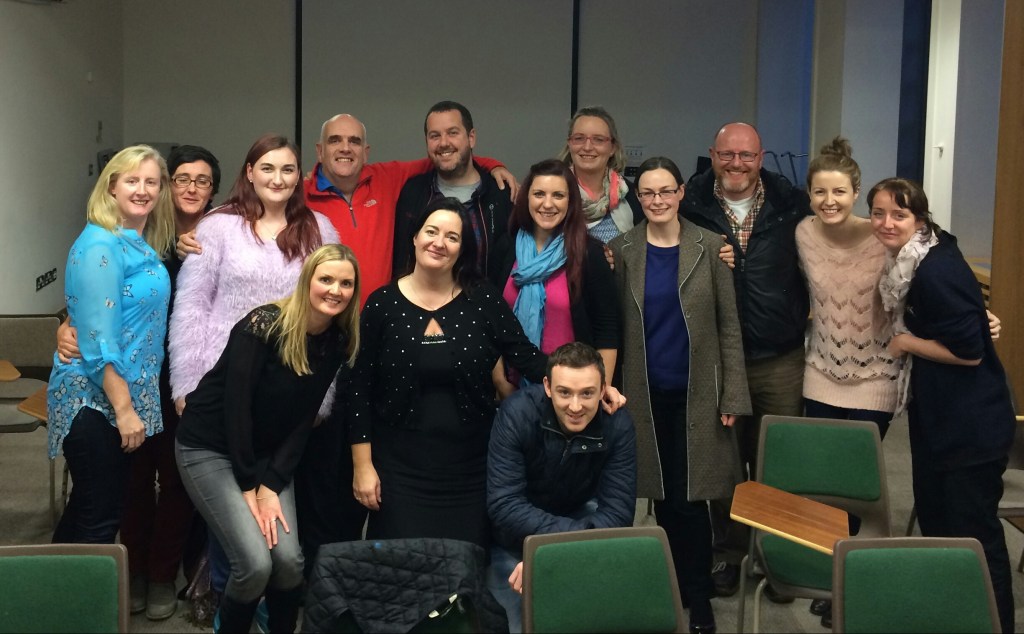
Recently CISLI members enjoyed a great training session delivered by CISLI member Lisa Harvey and the Centre for Deaf Studies’ Dr John Bosco Conama.

Hello all
A quick announcement that our Annual General Meeting will be held on
SATURDAY 14 JUNE 2014
at
2.00pm.
DEAF VILLAGE IRELAND,
RATOATH ROAD,
CABRA,
DUBLIN 7
Notice for Motions and Committee reports will be distributed 6 weeks before the date.
Regards
CISLI Committee
CISLI are very happy to announce that they now have a Committee back to (almost!) full strength.
Following a meeting of current and prospective members on 28 November in Deaf Village Ireland (in place of the proposed Extraordinary General Meeting, now deferred until Jan 2014), three interpreter members have been co-opted to general Committee duties until the AGM in 2014.
The interpreters who have come forward are:
Cormac Leonard
Michael Feeney
Colm O’Sullivan
Also, Caroline O’Leary has expressed her willingness to remain on the committee, with Board of Evaluators of Interpreting (BEI) matters in mind.
We would like to welcome them on to the Committee, where they join Acting Chairperson Frankie Berry, Treasurer Darren Byrne, and IDS representative Kevin Mulqueen.
We are currently looking for a Centre for Deaf Studies student to become our Student Representative, and will hopefully have secured someone for this position by the EGM in January.
We look forward to seeing CISLI members in January for the EGM.
Regards
The CISLI Committee
Transcript and translation by Cormac Leonard, CISLI Co-Secretary
Download an MP3 of the interview here
[0.00] Eh now, so many people were watching the Nelson Mandela memorial, and then at one stage various speakers were up, they were doing sign language for the deaf community to understand what was going on. And its now been revealed that the sign language … one of the terms used was gibberish! Because the guy who was doing the sign language wasn’t qualified. Quite bizarre how he actually got on stage as such, to… in front of two of the most … well, two of the biggest diplomats, two of the biggest statesmen in the entire world. Anyway, gonna talk about that right after these. Stay where you are.
—
[0.34]Okay, just mention the fake sign language interpreter at Nelson Mandela’s funeral, which is a huge embarrassment – I mean, it has gone around worldwide. The Irish Deaf Society have released a statement, let me bring you this, we’re going to talk to a sign language expert in a minute –hhmmhhmm- excuse me.
[0.50] ’The Irish Deaf Society has united with the Deaf Federation of South Africa in outrage at the appearance of an unqualified and unrecognised sign language interpreter at the funeral of Nelson Mandela on Tuesday. The IDS places the responsibility on the South African ANC government for their part in the management of arrangements for the event. The DFSA director Bruno Druchen confirmed that the interpreter was not using South African Sign Language, adding that he “has made a mockery of South African Sign Language and has disgraced the South African Sign Language interpreting profession”. The unrecognised ‘fake’ interpreter stood next to South African President Jacob Zuma and American president Barack Obama during their speeches as he feigned to translate their words into sign language for the Deaf South African population. The event raises the issue of security as well as professional vetting breaches that deceit can lead to an unknown individual being granted access to two world leaders on a globally broadcast stage.’ … Quite unbelievable. Emmm… ‘Wilma Newhoudt-Druchen, {I’m reading it as it is}, the first deaf woman to be elected to the South African Parliament took to Twitter to expose the imposter and to direct accountability towards the ANC for their fundamental role in the blunder before ending “He cannot sign. Please get him off.” ‘
…This is quite… the chap then, who actually … I was reading this further last night, the interpreter then – and he can be seen at other events on YouTube, he has been used before by the ANC, and they traced him and they got him onto a radio station in South Africa, where he said he was having a ‘schizophrenic moment’ , and that he was ‘overtaken by various voices in his head’. This is what he said, live on radio in South Africa. And that he didn’t know how to sign, he just wanted to sign all the different voices. How could this possibly happen? You’d imagine you’d have to be an expert to be chosen to be at the funeral of Nelson Mandela and to do the sign language for all the major speakers and diplomats.
[3.02] Cormac Leonard is on the line. Cormac, how are you?
CL: Hi, Colm, how are you doing?
CH: Cormac has been a sign language interpreter for 8 years, got interested in it through the Irtish Sign Language evening classes, and you did a Masters’ thesis on Deaf politics?
CL: That’s right, Colm, yes.
CH: Quite interesting that, and that’s covering politicians over the years is it?
CL: Amm, it would have been covering the politics between the different Deaf organisations that were active at the time.
CH: Okay. And you’ve worked on RTE’s Hands On programme for Deaf people, for two years as a researcher – obviously you’ve done – so did you watch this on television?
CL: I wasn’t watching it live, Colm, but certainly you know the word spread very quickly after it was televised, and I’ve seen the clips, and I’d have to go along with everyone else’s opinion on this; this man was totally fake, what he was signing was gibberish, and made absolutely no sense in any language.
[3.55] CH: So there was nothing? It wasn’t even a case of … he was pulling different bits from different languages – this just was simple gibberish?
CL: Yeah… it was quite interesting, there’s a YouTube clip that was made of one of the channels’ coverage and it had an in-vision interpreter, one of the little boxes in the corner of the screen where a qualified South African Sign Language interpreter was used, and if you look at the two… performances, as such, if you want to call them that, it’s very interesting, because there’s a clear difference. Essentially the gentleman who’s being accused of being an imposter was using the same sequences of nonsensical signs again and again and again, regardless of who the speaker was, regardless of what was being said. Whereas the actual professional interpreter in the in-vision box was essentially translating everything that was said, and was translating the crowd’s reaction as well. So for example at one point President Zuma was booed very loudly by the crowd and any professional interpreter would be translating that as well, and giving that information to Deaf viewers that that was happening, and that didn’t happen at all with … with the imposter.
[4.58] CH: I’d imagine… I mean, okay, I know it’s gone around viral on YouTube, and you know, it’s going to be made a mockery of unfortunately as well and you know, you can see the likes of David Letterman and Jay Leno already, his scriptwriters, but for the Deaf Community, that must be just so … embarrassing, annoying, and upsetting?
[5.17] CL: Absolutely, I think the Irish Deaf Society’s statement has made that very clear, what the Irish Deaf community’s position on that is. I mean as a professional sign language interpreter there’s considerable anger among our community as well, just in terms of the sheer unprofessionalism of the entire, um, event. And I mean, I think what’s very interesting is something that the Irish Deaf Society’s statement raised, which was security concerns. They had no idea that this man was a qualified or accredited or recognised sign language interpreter, but he could have been… he could have been anyone, he could have been an assassin, there could have been … you know, a lot of an uglier scene there on the day, but, em… yeah, interpreters across the country are just very, very upset and angry about this.
[5.56] CH: Did it… again, with the Deaf community, did it start almost immediately on Twitter and social media, that, like, what the hell is this guy doing?
CL: Yeah, I mean you very quickly saw posts going up and then followed by YouTube clips and, ah … word spread very quickly, I think late last night, I saw the post go up about, oh, we finally unmasked who the imposter is, and then today, this morning again very quickly, the story spread about the so-called psychotic episode so, I mean, yeah, the Deaf community has been buzzing about this.
[6.27] CH: And obviously how as you said he got onstage. And he had been used before! The previous times, which I think are now going around YouTube, at a previous arrangement with President Zuma – was he making any sense then? Do you know?
CL: Um, I haven’t seen those early clips myself Colm, but apparently not. Like there’s been a few Deaf colleagues of mine have posted on Facebook recently that, oh this guy apparently has been doing this for years. And I think that’s, that’s kind of the way it can go, and Ireland is no stranger to these kinds of situations as well, and sometimes people can get a long way before being caught or recognised as being fraudulent, because essentially there’s no quality control. There’s no kind of regulation of skills or qualifications whatsoever in this area.
[7.13] CH: Okay, well tell us then, Cormac, for you, how do you become a sign language expert?
CL: Well Colm, for this country, I suppose I can speak for Ireland, really – if one wants to become a sign language interpreter, at a professional level, there is a 4 year Degree course in ISL / English interpreting, ISL being Irish Sign Language. And that’s offered by the Centre for Deaf Studies in Trinity College. So that’s … so pretty much, the Centre for Deaf Studies qualification is your baseline standard for interpreting skills here in Ireland. And after that you’re qualified to do a certain level of interpreting job – obviously other kinds of jobs that are more prestigious or more …. I suppose technical, or more high risk, would require additional qualifications and skills.
[7.57] CH: So for this guy to be hired… he should have had some kind of certification or … you know, some sort of certificate, or some- but obviously no one even looked for it. I mean, would you be asked, if you were taking on big job? Do you have to show that you have the ability?
CL: Um, you would, yes. I mean, I think the norm for interpreters around the country now is that we are booked using sign language interpreter agencies. And there would be three main agencies around the country and they would each have, I suppose, their own systems of controls there in relation to what interpreters are put into what jobs. But the bare minimum is that you would have that third level qualification, that you would have those basic skills that have been tested, and that is your passport then to your career, really. If you don’t have that level of skill, if you haven’t demonstrated that level of skill in some way, then essentially you don’t, you can’t really use the title of professional sign language interpreter, or really, the title of interpreter at all.
[8.50] CH: Is it very different through all the different countries?
CL: Um, it is, um…
CH: Is it as different as language itself, yeah?
CL: It is indeed, yeah, I mean, Irish Sign Language I think, I know there’s been a lot of work in the last few months by the ISL Recognition Group who are attached to the Irish Deaf Society, who are trying to get recognition for Irish Sign Language, which is grammatically different from both the Irish and the English language. It’s essentially the sign language that we use here in Ireland. It’s got its own grammatical structure. It’s not just using the hands either, Colm, I suppose it’s a language of the hands the face and the body. If you’ve ever seen a true signer from the Deaf community tell a story or give an impassioned speech, you can just see how beautiful and rich a language it is. It differs then from country to country, so Britain would have its own British Sign Language, BSL. America would have its own, and there’s as much diversity in the Deaf community and the sign language world as there is in the spoken language world.
[9.43] CH: And would you be able to read, say, an American Sign Language interpreter?
CL: Um, myself personally, I don’t have a great level of American Sign Language, um… I would have a certain level of British Sign Language but um… yeah there are, one thing that is often said is that for Deaf people themselves, who are you know, essentially masters of the language they have been using all their lives, it’s a lot easier for them to cross those cultural and linguistic boundaries and to, you know, very quickly be able to communicate with Deaf people from other countries. But I myself, no!
[10.13] CH: Do we have two sign languages in Ireland?
CL: I think there’s a lot of… I suppose… misinformation around that. I know that in parts of the North of Ireland, Irish Sign Language is used, but for the most part in the North of Ireland among the Deaf community, British Sign Language is used. And that’s to do with where Deaf children would have gone to school, the kind of sign language they would have picked up then. But for the Republic of Ireland, essentially one sign language is used, which is Irish Sign Language.
[10.43] CH: Okay. And just to say, how long is it for you to actually become … and to get that certificate at the end? How long does it take?
CL: The degree at the moment, Colm, is four years. It used to be a 2 year diploma and the most recent cohort of graduates from the Centre for Deaf Studies actually have been the first to possess that four year Degree. So that’s an amazing achievement as well. But prior to that, you’re always recommended to have some level of sign language skills going into an interpreting course. And it does take years and years and years to become really fluent to the extent that you need to be, I mean I’ve been learning sign language for, I would say, coming up to twenty years. And I still don’t consider myself fluent enough sometimes for the kind of challenges that I have to deal with day to day. It’s an extraordinarily involved process to interpret between two languages at the same time, and it’s an extraordinarily rich language as well that the Deaf community possess.
[11.34] CH: And do you know the way every year, there’s about 50 or 60 new words go into the Oxford Dictionary – you then have to translate them into sign language?
CL: Ummm… if and when they come up, yeah. I mean, quite often…
CH: I’m just thinking a simple thing like, twerking became a big word.
CL: …yeah. Now to be fair I haven’t heard the sign for TWERK come up just yet in ISL. I’m dying to see it!
CH: I’m dying to see it as well!
CL: Well I tell you Colm if I find out what it is, I’ll be sure to send you a video clip!
CH: But like Twitter for instance, a new word let’s say, in the last couple of years. Twitter?
CL: Twitter, yeah. There is a sign for Twitter, for tweet, for Facebook, so all these words used by hearing people will eventually filter into the Deaf community and signs will be created for those terms and the language grows and builds and expands the same way as any other language.
CH: And who makes that final decision? In other words, like, there’s a group or there’s a committee for the Oxford Dictionary that sit down and go, okay, well, we’ve seen cultural references to this word, so we now need to bring it in… who decides what that will be, and what the standard of sign will be?
CL: Ammm… essentially the Deaf community decides, Colm, I mean it’s just a case of, you know, you might have a particular sign begins to be used, it’s not always recognised by all Deaf people straight away but it will begin to filter into the community and begin to be used, in much the same way as new words appear and spread out into the English language speaking world.
CH: It’s fascinating. So what do you think is going to happen to this guy? I mean…
CL: Um…. I’m not well placed to say what should happen to him. I think maybe a positive that has come out of this is, an attention on the profession of sign language interpreting itself, and the need for quality standards. I mean, just one thing to emphasise is that, there’s been a lot of talk in the last 48 hours about this gentleman being, you know, ah… you know, a bad interpreter or a non-qualified interpreter; he wasn’t an interpreter. He was a non-interpreter. He was just a guy who was literally making stuff up as he went along. And I think it is… you know, our profession has, I suppose, enough difficulties in getting recognised at the moment as it is, without this kind of thing happening. So the emphasis really needs to be on quality standards, it needs to be about fluency, the appropriate qualifications and accreditation that an interpreter might need, and the emphasis should be on the Deaf community and their access to everyday life as citizens of this country, through high quality interpretation.
[13.58] CH: In a strange, bizarre way, this is what has been highlighted literally in the last 48 hours which I think is interesting as well. If any good can come out of it, it could be actually that. And a greater focus on the need, you know, for the Deaf community to be brought into all events like this, you know.
CL: Absolutely. And to be consulted as well, on any kind of moves to give them access by any state or private body.
CH: Okay Cormac, good talking to you, and we’ll be looking out for the sign for TWERKING!
CL: Great! Thanks very much Colm.
CH: Good talking to you. Take care of yourself.
Fascinating, isn’t it? Absolutely fascinating this guy got away with it. I suppose it’s like the guy that used to jump into pictures of the Man United squad or – a gatecrasher, basically! But that he got away with it! In front of… the viewing must have been up to about a billion, maybe? And that he was there for how long? It’s gone all over the Internet now, it’s gone viral. I just find that remarkable, But anyway … that’s the way of the world sometimes, isn’t it? It just fascinates you, it’s unbelievable sometimes.
Cormac Leonard’s EFSLI Report, 2012 Conference (Part 2)
Guten morgen!
Here’s part 2 of my report from EFSLI.
First of all, the costume ball was fantastic – definitely a visual spectacle at the Palais Auersperg, where participants dressed in all kinds of fabulous gowns and getups. Former and current efsli board members were remembered and honoured. It was certainly a hedonistic night to match those of the Austrian Emperor’s court in the eighteenth century! I got talking to British, Italian, German, American and Australian terps and once again was amazed at the differences – and similarities – between us. While many partied long into the wee hours of the night, I wended my way homeward at a respectable enough 2am!
I think it only fair to say that I missed the first presentation on Sunday morning – hey, this international networking takes a lot out of a person, recharging is needed!! – but Patricia Bruck’s “Power and Responsibility in Interpreting Situations: The Views of Austrian Deaf Customers” received good feedback from those present.
Deb Russell’s presentation ” Interpreting Decisions and Power: Legal Discourse or Legal Discord?” (co written with Risa Shaw) looked at Deaf/hearing interpreter teams in legal settings – the interplay of power and teamwork in these situations and how that power can sometimes be misused. Alongside the outlining of the ‘dream team”s configuration and the ideal teamwork and preparation needed for these assignments, points were raised in Q&A about the ever growing issue of money – what to do when courts will not pay for a second hearing interpreter, let alone a Deaf interpreter(s) added to the team? Deb felt that we as interpreters needed to use the language of the courts to influence decisions to bring in Deaf interpreters – to stress accuracy, comfort, lessening the risk of retrials etc. when such a configuration was used as best practice. She also mentioned the power hearing interpreters have to ‘gatekeep’ in recommending – or not recommending – that Deaf interpreters be brought in to a situation to begin with.
Following a break there was a plenary session where participants could make contributions in International Sign, English, or OGS (Austrian Sign Language). The results of the parallel sessions from the previous day were given by rapporteurs. Christopher Tester reported that his group had discussed team work’s advantages; 1 + 1 = far more than 2! Working with a colleague brought something far more valuable and advanced to the situation.
Ingeborg Skaten’s group had gone over issues relating to our profession, such as – who gets to define our work? If we do not, how are we a profession? Can a profession exist in the first place without a national association? In these cases, it may be problematic to call ourselves (on a pan-European basis) a ‘profession’ when these features were often missing for member countries. Yet Ingeborg raised the point that we do have a collective identity and were in many ways, if not a profession, then certainly a ‘family’ – sharing common experiences, practices and skills. Zane Hema, in his usual charismatic and incisive style, reported back on his group’s work on Codes of Ethics co-existing with the interpreter’s own judgements as a person, and the power management aspect of this.
There then followed an open discussion which was wide ranging. There was much talk of the relationship between Deaf and hearing interpreters, a subject which seemed to dominate the conference; Zane Hema and Chris Stone pointed to the long and illustrious history of Deaf interpreters and made the point that this long expertise as well as the common experience within Deaf communities of interpreting for each other, regardless of qualifications, was a resource we needed to use. Verena Krausneker made a lovely analogy towards the end of proceedings; to date hearing interpreters have been sitting in their own compartments of an old fashioned train. Now, Deaf interpreters are asking to take their seat in the compartment. Hearing interpreters sometimes grumble at having to share their space; others may welcome the company. Others still may talk eagerly to their new travel companions… whereas some may even leave the train together and find a house to share domestic bliss together!
The issue of signing at such efsli conferences was also raised; some participants objected to the use of speech among participants, but other interpreters were quick to point out that their knowledge of IS was often zero and therefore it was difficult to begin. On a personal note, I found it lovely to try my best to communicate in IS, and it’s a rewarding experience, but I can empathise with the point that without some knowledge of it, it’s hard to confidently begin that conversation. EFSLI would do well to produce some kind of beginner’s ‘survival guide’ to IS for attendees, so that those arriving would be able to have some toehold – and through networking and socialising, be able to climb up the IS ‘ladder’.
After this discussion was wrapped up, Darja from Slovenia presented on the 2013 efsli conference, to be held in Ljubjana. I was charmed by her hilarious presentation – and am certainly now aware that she is in fact not the only Slovenian in the world, and that her country is shaped ‘like a chicken’! The conference will focus on technology and its relationship to interpreting. See here for more details:http://www.efsli.org/efsli/efslievents/2013/efsli2013.php
Overall I had a fantastic time in Vienna and was impressed by a well-run conference. As always I was blown away by the work of the Deaf/hearing interpreting teams working with International Sign, but praise is also due to the team of OGS interpreters working from English, into German, then into Austrian Sign.
Right, time to sightsee and buy pressies for everyone. Auf Wiedersehen!
Cormac Leonard’s EFSLI Report, 2012 Conference
Gruss gott von Oesterreich!
It’s been a really lovely time here so far in Vienna, where I’m attending the European Forum of Sign Language Interpreters (efsli)’s 2012 Conference, “Power and Responsibility in the field of Sign Language Interpreters”.
I definitely cannot fault the choice of location and venue. It’s my first time in Austria and I cannot get over how breathtakingly beautiful the city is. Everywhere you look, works of art are proudly positioned at street corners, every building is an architectural wonder. Fans of history (check!) will lose themselves in the broad streets and fans of coffee (check!) will love the chance to while away an hour sipping a latte – even if they are a little pricey!
The AGM was held yesterday, but I wasn’t able to make it, so today was my first taste of the international and cosmopolitan scene that is an efsli event. I’m also meeting my friend Bec Schultz, an Aussie interpreter whom I met at WASLI in 2007, and her fiancé, and have already bumped into a number of other familiar faces!
The conference began with the announcement that Marinella Salami has been made the new efsli president. As well as this, a historic agreement has been signed between efsli and the European Deaf Blind Union. Exciting times. The conference will focus heavily on the relationship between interpreter organisations and Deaf organisations, something of interest to Irish interpreters as we look back on our first year of CISLI and our structural links with the IDS.
Patricia Shores-Hermann, currently based in Switzerland, began the presentations by looking at ‘Issues of Power and Responsibility in Sign Language Interpreting and Within Sign Language User Communities’. She analysed what ‘power’ was and reflected that individual signed languages’ signs for the concept may in fact be misleading; power was in fact an ability to control rather than to be controlled. Her presentation reflected many of the issues that have faced us here in Ireland in IASLI and following its demise, in the negotiation for a new organisation, as well of course as touching on many of the day to day concerns we have felt and articulated to each other.
Flora Savvalidou of Greece gave a fascinating talk on ‘Identity Issues in Sign Language Interpreting: The Power and Responsibility of Representing the Identities of Others’. As individuals, hearing people, Deaf people, interpreters – all of us have a selection of identities which we construct from elements of meaning, and are constantly comparing our self-image and notion of our own identity at the time, with the feedback we receive from others that bolsters, or challenges, this self view. So when we approach the interpreted interaction, which of our identities is pre-eminent in us? Can our interpreter-mediated contributions cause responses that are reactions to our identity, rather than the other interlocutor? Are we sometimes too attached to our interpreter identity and are convinced that a bad interpretation on our part will make us appear to be a bad person? This was a fascinating tool to analyse interactions and our own positioning in the interpreted event.
Mark Wheatley of the European Union of the Deaf discussed his efforts to lobby MEPs at Strasbourg during a recent successful subtitling access campaign, and how vital it was to have interpreters when lobbying the MEPs face to face. Of particular importance was sourcing interpreters fluent in multiple spoken / signed languages, as well as matching those interpreters with Deaf campaigners who would be knocking on office doors in the European Parliament. Power and status related discussions were key to a smooth and effective match between lobbyist and interpreter, and ultimately to the successful campaign. An entrancing look into the world of sign language interpreting at the highest echelons within the EU.
Isabelle Heyerich of Belgium (assisted via International Sign videoclips by Maartje de Meulder, her Deaf interpreter colleague) discussed the pilot use of interpreters on Flemish television – in particular a situation whereby a Deaf and a hearing interpreter were selected, and the issues around control, fluency, language ownership and perceived competition that arose. The Flemish national broadcaster piloted the use of Deaf interpreters for the news in 2011, and it certainly made me proud to think that Ireland has actually had at least 35 years of signed news, and for decades we have had Deaf interpreters carrying this out – though it is only recently that we have begun to think of these colleagues as ‘interpreters’. My conversations with other conference attendees makes me realise how very rare this is around the world.
Following lunch and a poster exhibition, there were three parallel sessions, and I attended Ingeborg Skaten (from Bergen University) discussing ‘The power of the profession, taken for granted?’ which took as its starting point the definition of ‘a profession’. (One very interesting point for me was a definition used that said ‘A profession cannot be said to exist without a national association’, as well as stating that most people who carry out the specific work in question need to be doing it on a fulltime basis.) Ingeborg looked at Norway’s interpreter provision system – a highly advanced one where a government funded agency deals the vast majority of interpreting, but where recent proposed changes involve a possible re-examination of the role of the interpreter – possibly without full discussion with the interpreting and Deaf communities. A lively workshop followed.
And that was all for the day. Now it’s time to get my dancing shoes on and prepare for tonight’s ‘Night of Costumes’ 20th efsli aniversary ball. I’m being extremely unimaginative and dressing as… well, pretty much as an interpreter! But as disguises go, I reckon it’s quite an easy one to slip into …!
Council of Irish Sign Language Interpreters
Annual General Meeting
Saturday 19 May 2012, 11.00am – 4.00pm
Games Room, Drumcondra Deaf Club, Dublin
 Council of Irish Sign Language Interpreters