CISLI were extremely fortunate to have Caroline McGrotty and Dr John Bosco Conama present to over 30 of our members in the Centre for Deaf Studies, Dublin, on the 13th December.
Caroline McGrotty gave a fascinating presentation on her research on third-level education interpreting, which featured discussion of the importance of trust, the relationship between Deaf student and interpreter, the role of the disability officer, and much more.
Dr Conama presented on the ISL Bill, currently before Seanad Éireann, and how its provisions would affect interpreters. He explored the various provisions in the Bill around registration, a possible ‘voucher’ system, sanctions for unregistered interpreters, and much more.
Heartfelt thanks to Dr Conama and Ms McGrotty, and also to the Centre for Deaf Studies for allowing us to use their room.
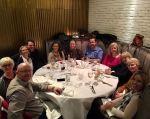
Afterwards, we headed to the nearby Porterhouse where we indulged in a little festive revelry!
Merry Christmas and Happy Holidays to all CISLI members!
Saturday saw a highly successful training day for CISLI in Limerick, where a large group of Deaf and hearing interpreters and trainees took part in the ‘Working with Deaf Interpreters’ training session, delivered by Teresa Lynch and Frankie Berry.
The session began with an exploration of Deafhood and colonialism as it related to the Deaf community, before linking in to Teresa Lynch’s own research into Deaf interpreting. She told us that Deaf interpreting for many Deaf people is an activity that has been happening for years – many Deaf people have been interpreting since childhood but not known this was the term for it!
Following lunch, four roleplays were held, to help us understand the complexities of Deaf-hearing interpreting team dynamics in medical, legal, mental health and conference settings. These really brought home the range of work that Deaf interpreters do.
After the training, a General Meeting was held with members of CISLI old and new, with our Chairperson, Cormac Leonard, updating members on national developments and local members discussing concerns.
Many thanks to all who attended both events! We hope to have another training day in Dublin in February / March.
Attendees at our training day
Attendees attending attentively…
Teresa Lynch makes a point
Exploring colonialism and Deafhood
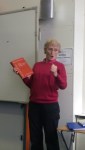
Frankie Berry identifies the author…!
Frankie Berry recommends some reading material
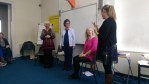
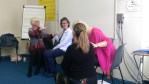
Participants in one roleplay
The roleplay showing how complex Deaf interpreting can be
In this clip our Committee members Amanda Mohan and Ciara Grant give a short report on their visit to Brussels for the EU Parliament’s Multilingualism conference – featuring over 140 interpreters working at the same venue!
A short video that we’ve produced to celebrate ISL awareness week. Interpreters Deaf and hearing, students and professionals, declaring their love for Irish Sign Language.
Well, we have certainly had a busy first couple of months as a Committee!
Hot on the heels of our first Committee meeting in July, we promptly set up two new SubCommittees. Firstly, we have a SubCommittee looking at Occupational Health and Safety; this group will be looking at working conditions and physical risks for interpreters and will develop a draft Policy for CISLI.
We have also formed a group to look at the creation of a Grievance / Dispute policy. This SubCommittee is strictly in the researching phase at the moment, gathering best practice from other comparable countries. More news on these new SubCommittees soon, as well as updates to existing Sub Committees.
We have a great October training session lined up – Teresa Lynch and Frankie Berry will deliver a session for CISLI members on Working with Deaf Interpreters on Sat 22 October in Limerick. This will be followed by a General Meeting of CISLI members.
The Training Sub-Committee also plans to hold a series of talks in Dublin on midweek evenings on various interpreting – related topics – free for members. Again watch this space!
We have also been introducing ourselves to the many agencies that provide sign language interpreting services. The range of such organisations is important for us to keep abreast of. New companies entering the industry have received introductory letters from us, and we hope to have face to face meetings through the year with agencies and develop good working relationships with them.
Another change we have made is to the Student Representative position on the Committee. We feel that a reconfiguring of the role should take place to maximise the position’s usefulness. Therefore we have decided that Ciara Grant, our current Student Representative, will act as a New Member Liaison until the upcoming AGM. She will become a full voting member of the Committee and focus solely on the needs and queries of both CDS students and newly-qualified interpreters. The Committee will propose a Motion to make the corresponding changes to the Constitution next year.
We are committed in 2016/7 to work on such matters of national importance – liasing with agencies, old and new; exploring possibilities around our own grievance procedure linked to our Code of Ethics; health and safety and good conditions for interpreters; and discussion with other parties about licensing and/or registration of interpreters post-qualification.
Yet this national focus, our small size, tiny budget and voluntary nature means that prioritisation must occur. CISLI regrets that it was unable to attend this year’s efsli AGM. We had sent out informal apologies previously to efsli, and are disappointed that once again, the limited finances of CISLI and the very busy professional and personal lives of our volunteer Committee did not permit attendance. We are also confirming that CISLI will have representation in 2017 for efsli in France, as well as other interpreter related events through the coming year.
But none of the goals and campaigns we wish to work on, for all of us, can be achieved without member support. Our paid membership numbers are currently the lowest on record, however. Without members, CISLI cannot represent interpreters. We cannot plan.We cannot advise. We cannot work on those areas that interpreters are now vocally insisting are vital to work on. We need people to join the organisation. We need your help.
We encourage you to come to our training events, meetings, and get involved with our Sub-Committees. Let us know how we can help you. Let us know where we are falling down. Let us be stronger together, so that we can represent this growing profession, support each other, and move forward with the Deaf community to a better future for all of us.
Regards
Warm greetings to all from the newly elected CISLI Committee!
As Chairperson I would like to thank my fellow CISLI members for their support. I will do my utmost in the coming years to help grow the profession, build bridges between interpreters and the Deaf community and the wider world, and to build up solidarity amongst interpreters themselves. This, I believe, is central to moving forward with interpreting in this country. I have seen much to encourage us over the last few years in this regard.
Yet today in 2016, five years after the Irish interpreting profession re-established itself in the form of CISLI, problems remain, and new issues abound. As access becomes less of a right and more a commodity, an ever-tighter State focus on ‘value for money’ shifts the ground under our feet. New agencies – providing both spoken and sign language interpreting services – proliferate. Major interpreting contracts in colleges, hospitals, courts administration, and other public services such as the Garda Síochána, are snapped up and agreed on – without any user or practitioner involvement. Deaf people and interpreters are often bewildered at the rapid pace of this change; it often seems like those who are most likely to control provision of sign language interpreting services are the least likely to understand the unique nature of interpreting and the Deaf community.
CISLI Chairperson, Cormac Leonard
Interpreting remains a job without a clear career path. Interpreters’ fees, having not ‘officially’ been raised for many years, are now under downward pressure, which is often perceived as a ‘race to the bottom’. Terms and conditions for interpreters – especially in relation to team working and breaks – are continually under threat. We are often told of the shortage of interpreters – but we still struggle with a sharp decline of work in the summer time, and we still hear of colleagues for whom interpreting alone cannot pay the bills. Indeed, many valued colleagues have recently left the profession because it could not provide a steady income.
For the Deaf community, there are more interpreters, but issues of quality still rankle. While the vast majority of practitioners possess a third level qualification, and new entrants to the Centre for Deaf Studies benefit from a four-year degree programme, the profile of entrants has shifted; prior knowledge of ISL and the Deaf community is more often the exception than the rule. The Deaf community have been steadfast in insisting that interpreters, in their training and as part of their profession, develop stronger links with the Deaf community; but, as in other countries, these links are often weak or absent. Agency complaints procedures are unclear and often seem ineffective, and there is still no statutory or even voluntary form of registration of interpreters.
What can we do? CISLI can play a huge part in tackling these issues. We need a strong body that represents interpreters. We are few in number and diverse in opinion. But we can focus on what is common amongst us all, and strive to put in place for Irish Sign Language interpreting those features and systems considered mandatory in other jurisdictions. It will not be easy. It will take work. But it is work that needs to be done.
Members of the new CISLI Committee
In CISLI we intend to focus firstly on driving this energy by focusing on networking for interpreters. Our recent AGM saw us amend our Constitution, and now CISLI will have two Ordinary Members’ Meetings per year (one outside Dublin) as well as the AGM. We will also work on information gathering to make sure we have an accurate picture of interpreting agency provision around the country, and are proactive in pushing for appropriate terms and conditions for interpreters – regardless of agency.
We will also begin to look at wider issues of crucial importance to our relationship with the Deaf community. It is a desire of mine as Chairperson to examine the issue of complaints procedures. Many Deaf people are feeling poorly served by the existing complaints procedures of agencies. CISLI’s founding documents envisage us having a role in dispute resolution; we need to decide whether to excise these elements of our foundational documents, or to embrace them and develop a role in this area. It makes no sense to me for CISLI to have zero involvement in investigating alleged breaches of the CISLI Code of Ethics.
I feel we must also begin to proactively examine the area of licensing / registration of interpreting practitioners. No profession assumes that practitioners will remain at the same level of skill after qualification, without some form of structured CPD or further assessment of skills. We must grasp that receiving our qualification is the beginning, and not the end, of our learning. This has historically been a deeply controversial topic for interpreters, but we must respect the fact that Deaf people want, and deserve, a system of safeguarding to make sure the practitioners they work with have the capability to do the job.
None of these issues will be looked at without intense discussion with and between CISLI members. It is our hope that the majority of practising interpreters will join CISLI this coming year. We want a membership that is supporting and supported. We need a profession that is diverse yet united. And we want to widen and deepen our relationship with the Deaf community – without whom none of us would be where we are today.
Please let us know any thoughts or opinions you may have on our profession, in English or ISL. We look forward to working with you all.
Regards
Cormac Leonard, Chairperson
Frankie Berry, Vice Chair
Pauline McMahon, Secretary
Imelda Gibbons, Treasurer
Anthony Claffey, Ordinary Member
Amanda Mohan, Ordinary Member
Ciara Grant, Student Representative
Senan Dunne, IDS Representative
Council of Irish Sign Language Interpreters (CISLI) http://www.cisli.ie cisli.ireland@gmail.com
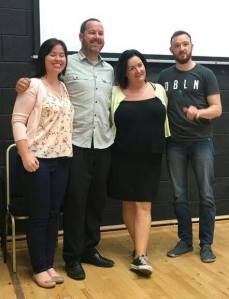
Members of the new 2016 CISLI Committee. Left to right: Amanda Mohan (Ordinary Member), Cormac Leonard (Chairperson), Pauline McMahon (Secretary), Anthony Claffey (Ordinary Member).
I hope the summer is going well for you all, at least it is getting a bit warmer!
Apologies for the late notification, CISLI’s AGM will be held on 20th June 2015 at 10-12noon in the The Cabragh Hall in the DVI.
To open up CISLI bank account turns to involve more paperwork than expected. The committee have had to create a ‘Book of Rules’, which is attached. This Book of Rules needs to be passed at the AGM by members before the banks will allow us to open up an account. So do have a read prior to the AGM. This will make it much easier for many things as you can imagine, particularly allowing people to become members online.
The committee are encouraging anyone who may not be a member to join, which can be done on the day. Membership forms can be found on the website and if you fill them out before you arrive it would be a great help.
As you may have notice the time allocated for the Annual General Meeting will be from 10am -12noon. The committee would like to invite you, as interpreters, to make the time to meet, catch up and get to know both ‘new’ and ‘not so new’ faces, to stay on for some light refreshments, such as sandwiches, wine and non-alcoholic drinks as well as tea & coffee.
Could you confirm your attendance so that we can plan how much refreshments we need to order.
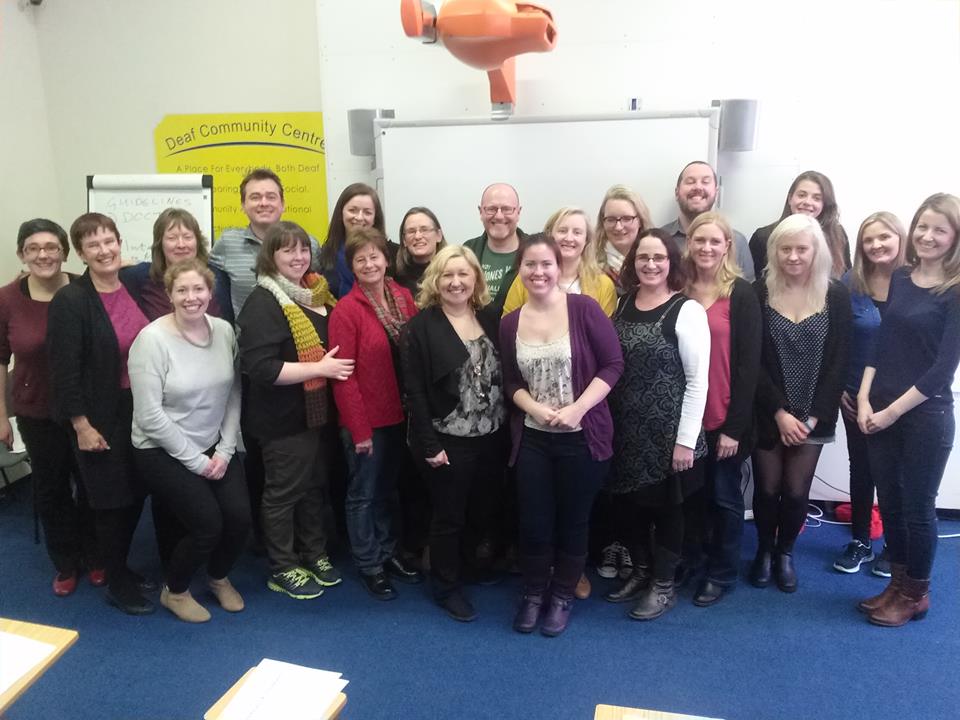
Attendees at the Mental Health Interpreting training in DCC Limerick
Thanks to all who attended our Mental Health interpreting training today and thanks to our lovely hosts DCC Limerick.
Dr Margaret du Feu and Margaret Woulfe delivered a fascinating and engaging look at Deaf people and mental health issues and considerations for interpreters.







 Council of Irish Sign Language Interpreters